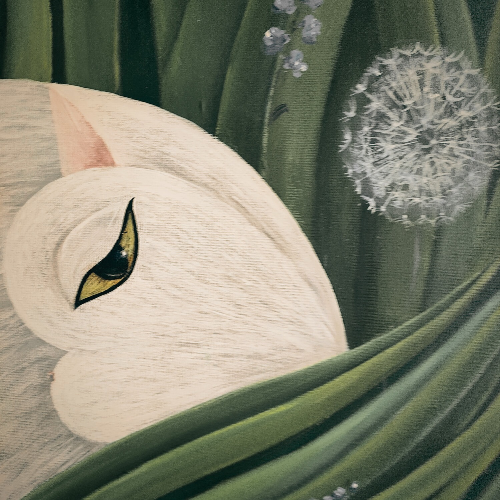

As I sit in my Southend-on-Sea studio, watching spring sunlight play across my latest geometric cat portrait, I find myself contemplating a question that’s becoming increasingly relevant in our creative landscape: What role should artificial intelligence play in art? As both a traditional artist and someone deeply invested in the evolution of creative expression, I believe it’s time to explore this topic with nuance and practical insight.
The Dance Between Human and Machine
When I create my nature-inspired artwork, particularly my current spring collection featuring black cats with dandelions and forget-me-nots, every element emerges from a deep well of lived experience:
– The way morning light filters through Essex coastal mist
– The texture of acrylic paint on canvas
– The geometric precision learned through countless hours of practice
– The subtle influence of my Polish-British heritage in color choices
– The personality of each pet I’ve portrayed
This human experience – layered, complex, and deeply personal – forms the foundation of authentic artistic expression. But where does AI fit into this creative ecosystem?
Understanding AI’s Role in Art
As someone who works primarily with traditional media, I view AI as another tool in our creative arsenal – much like my brushes, paints, or digital design software. Here’s how I’ve come to understand its place in the artistic process:
1. As a Creative Catalyst
– Quick visualization of concepts
– Exploration of unexpected color combinations
– Generation of initial compositional ideas
2. As a Technical Assistant
– Pattern variations for geometric elements
– Color palette experimentation
– Basic compositional studies
3. As a Learning Tool
– Understanding different artistic styles
– Exploring new perspectives
– Analyzing compositional principles
The Irreplaceable Human Touch
What makes human-created art special in an age of AI-generated images? As I work on my spring 2025 collection, featuring pieces like “White Cat with Dandelions” and “Black Cat with Mixed Dandelions,” I’m reminded of several key elements:
1. Emotional Authenticity
– The ability to infuse work with personal meaning
– Understanding of cultural context and local significance
– Genuine emotional connection with subjects
2. Physical Craft
– The meditation of mixing exactly the right shade
– The satisfaction of achieving perfect geometric precision by hand
– The unique texture of brush on canvas
3. Intentional Imperfection
– The conscious choice to break geometric patterns
– The intuitive decisions that make each piece unique
– The beauty of human interpretation
Finding Balance in Practice
In my own studio practice, I’ve developed a balanced approach to incorporating AI while maintaining artistic authenticity:
For My Pet Portraits:
– Initial composition sketches may be AI-assisted
– Final execution always hand-painted
– Geometric elements hand-designed
– Color combinations personally selected
For Nature-Inspired Pieces:
– Traditional observation of local flora
– Hand-drawn geometric interpretations
– Physical color mixing and application
– Personal artistic interpretation
The Future of Artistic Creation
As we navigate this evolving landscape, I believe the key lies not in choosing between traditional and AI-assisted art, but in understanding how to maintain authentic artistic expression while embracing new tools. When I create my miniature paintings (12.5×17.5cm) or larger pieces (up to 30x40cm), each artwork represents:
– A unique human perspective
– Years of technical expertise
– Personal creative vision
– Physical craftsmanship
– Emotional investment
Looking Forward
The emergence of AI in art doesn’t diminish the value of human creativity – rather, it highlights what makes our artistic expression unique and irreplaceable. As I continue developing my seasonal collections and exploring new techniques, I remain committed to creating art that carries the unmistakable mark of human experience.
Questions for Fellow Artists:
– How do you balance traditional techniques with new technologies?
– What aspects of your creative process do you consider uniquely human?
– How do you see AI tools complementing rather than replacing artistic skills?
Next in our series, we’ll explore “The Soul in the Artwork: Why Human Touch Matters,” where we’ll delve deeper into the emotional and spiritual aspects of artistic creation.
- Behind-the-scenes of Artwork Creation
- History of Art
- Local Art Scene in Southend-on-Sea
- Nature and Cat Art Technics
- Navigating Social Media & AI in Art in 2025
- Seasonal Reflections
- Thoughts on AI Art, Traditional Art, and Creativity
- Uncategorized

 Milena Skulimowska Visual Artist
Leave a comment