
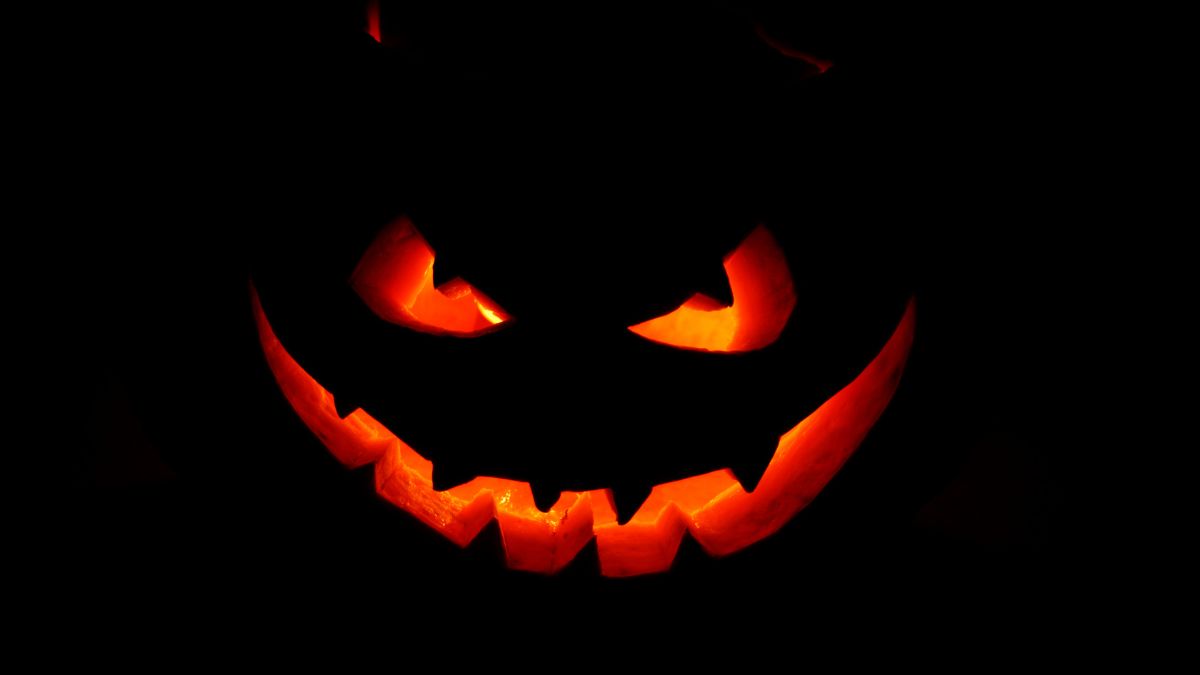
The town in costume
A few evenings before Halloween, the town starts to change its posture. Front gardens become stages. Porches turn into small theatres. A plastic skeleton lounges in a deck chair as if it has always belonged there. A row of carved pumpkins flickers like a line of patient lanterns. Cobwebs appear overnight, stretched across hedges and railings, as though the ordinary world has been briefly caught.
I notice it with a particular kind of fascination, because I didn’t grow up with Halloween in this form. I grew up in Poland, where the season has its own traditions and ways of remembering, but not this widespread, playful public performance of the spooky. Living in England, and seeing how naturally Halloween spills into the street—how confidently it takes up space—makes me look at it less as a simple holiday and more as a cultural language worth listening to.
Walking through these streets, I’m struck by how public Halloween is. It isn’t only something we wear; it’s something we place outside ourselves. We hang it on doors. We stake it into lawns. We let it face the pavement and the passers-by. And that makes me wonder: what are we saying when we decorate our homes with ghosts, graves, and grinning skulls?
Expression, but also permission
On the surface, it’s easy to call it fun. A seasonal hobby. A community tradition. A reason to buy a fog machine and pretend, for one night, that the world is made of candy and theatrical screams.
But Halloween feels like more than a theme. It’s a permission slip.
For a short window, we’re allowed to be strange in public. We can be dramatic without explanation. We can make our homes look haunted and no one asks if we’re okay. We can dress as monsters and still be welcomed at the door.
That permission matters because most of the year, we edit ourselves. We keep our fears private. We keep our oddness tasteful. We keep our intensity contained. Halloween loosens the rules. It says: you can show the shadow side, and the world will call it festive.

Why death shows up as decoration
The question that keeps following me down the street is this: why are we drawn to death motifs when the nights get darker?
There are skeletons everywhere—cheerful, cartoonish, sometimes elegant, sometimes grotesque. There are tombstones with jokes on them. There are witches, vampires, zombies, and the whole theatre of the undead.
It’s tempting to say we’re just playing with fear. But perhaps we’re doing something more honest: we’re acknowledging what we spend most of the year avoiding.
Death is the most universal fact of being alive, and also the least socially convenient. We don’t know how to talk about it without making people uncomfortable. We don’t know how to keep it near without feeling it might swallow the room.
So we turn it into a symbol we can handle. We shrink it into plastic and paper and light. We make it funny. We make it stylised. We put it on the porch where it can be seen, but not fully felt.
In that sense, Halloween is not a denial of death—it’s a domestication of it.
The beauty of the temporary
There’s another detail that feels important: all of this is temporary.
The spiderwebs will come down. The pumpkins will soften and collapse. The costumes will go back into storage. The fog will clear.
Halloween is a ritual of impermanence, and that may be its quiet lesson. We build a world that looks like an ending, then we pack it away and return to our normal lives. We rehearse the idea that things can change shape, that identities can be worn and removed, that the familiar can become unfamiliar and then familiar again.
Maybe that’s why it’s comforting.
It gives us a controlled encounter with uncertainty. It lets us practice letting go.
Costumes as confession
Costumes are often described as disguise, but I’ve never been fully convinced.
A costume can hide you, yes—but it can also reveal you. It can be a confession you’re allowed to make because it’s “just a costume.”
Some people choose beauty: glittering vampires, elegant witches, cinematic ghosts. Some choose comedy: inflatable dinosaurs, oversized masks, absurdity as armour. Some choose horror: the kind that makes you flinch, the kind that leans into what most people would rather not see.
Each choice is a small statement about what we’re drawn to, what we fear, what we admire, what we want to embody for a night.
And perhaps the deeper point is this: we don’t only dress up to become someone else. We dress up to explore the parts of ourselves that don’t fit neatly into everyday life.
There’s something quietly artistic about that exploration. Costumes and decorations are not only props; they’re a palette. We choose objects, textures, and colours the way an artist chooses materials—black velvet, orange candlelight, bone-white plastic, crimson accents that feel like theatre. Even the simplest porch display is a small composition: contrast, mood, symbolism, a story told without words. In that sense, Halloween becomes a public gallery of private imagination—one night where self-expression is not only allowed, but expected.
A community shadow-play
What I love most about walking through Halloween streets is that it’s communal without being demanding.
No one needs to explain their display. No one needs to justify their taste. One house goes full haunted graveyard; the next keeps it simple with a single pumpkin and a warm porch light. Both are participating.
It becomes a kind of neighbourhood conversation conducted in symbols.
Here is my sense of humour.
Here is my appetite for drama.
Here is how much fear I can hold while still smiling.
Here is how I want to be seen, safely, from the other side of the pavement.
And because it’s shared, it’s less lonely. The darkness becomes something we look at together.

What Halloween represents, underneath the fun
So what does it all tend to express?
Maybe Halloween is the season where we admit that life has edges.
That beauty and decay are not opposites but neighbours.
That fear is not only something to escape, but something to understand.
That we are, all of us, temporary creatures trying to make meaning in a world that changes.
And maybe the reason we’re drawn to death motifs isn’t because we love the idea of death, but because we’re trying—once a year, in a language made of costumes and candlelight—to make peace with the fact that it exists.
Walking home
As I head home, I notice how the decorations look different depending on the light. In the early evening they’re playful. Later, when the street is quiet, they become a little more serious. The same skeleton can be a joke at 6pm and a reminder at midnight.
That, too, feels like part of the point.
Halloween holds two truths at once: it’s fun, and it’s not only fun.
It’s a celebration, and it’s a reflection.
It’s a night where we laugh at the dark, not because the dark is harmless, but because laughter is one of the ways we prove we’re still here.


Leave a Reply